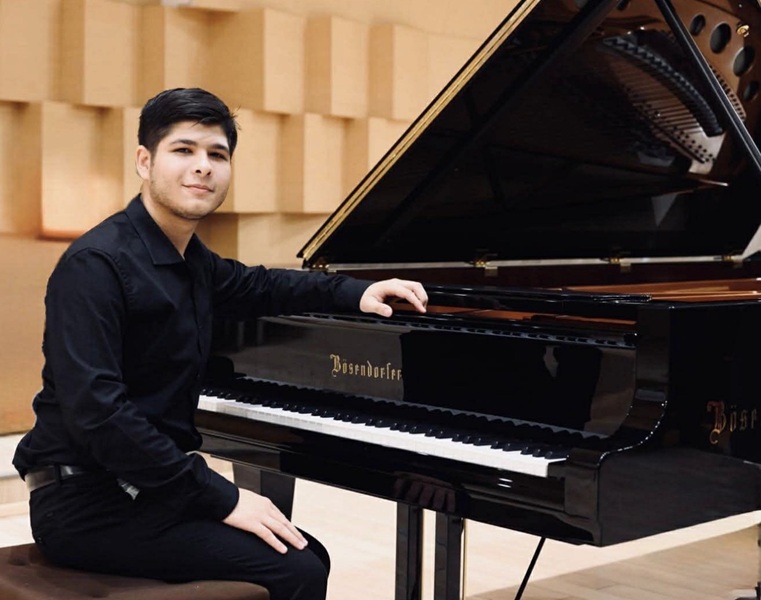
Interview
1. Your early artistic formation was guided by two distinguished Romanian pianists, Boldizsár Csíky Jr. and Maestro Mihai Ungureanu. How do you look back on your time with these masters?
Although I now find myself in a very different environment, I often look back with profound nostalgia on my years with Maestro Boldizsár Csíky Jr. He has been, and will always remain, an essential point of reference in my understanding of piano interpretation, for which I shall remain eternally grateful.
He taught me the secrets of musical sound and, in many ways, helped me purify my playing. From him, I learned that music often resides in the deepest silences, and that interpretation is not about demonstrating how loudly or quickly one can play. We are there to serve the music; we are, in a sense, its servants. A truly pure sound, I came to understand, cannot exist without humility and a certain purity of soul.
Maestro Mihai Ungureanu is equally extraordinary, a truly unique individual, distinguished by his seriousness and intellectual rigour. He taught me to examine the score down to its smallest details and, perhaps most importantly, transformed my entire perception of the piano. Through his guidance, I learned the importance of reflection before the fingers ever touch the keys.
2. You have mentioned that you were raised in a family of musicians. Could you tell us a little more about your upbringing?
Being born into a family of musicians is, to me, a gift from God. For a young musician, there is perhaps nothing more precious than growing up surrounded by music, breathing it in every day at home and inhabiting an environment in which it becomes a natural part of life.
It was actually my grandfather who first recognised my talent. In the beginning, I was far from enthusiastic about practising, and he had to insist that I sit at the piano. For a time, I studied largely because I was expected to do so.
Everything changed when I discovered the music of Wolfgang Amadeus Mozart and Ludwig van Beethoven. I fell deeply in love with classical music, and from that moment onwards, the roles were completely reversed. My grandfather would quite literally have to beg me to stop practising and come to the table for dinner.
3. At the age of sixteen, you made your orchestral debut with the Oltenia Philharmonic Orchestra in Craiova. How do you remember this important milestone?
Making my orchestral debut at the age of sixteen, in my hometown of Craiova, remains one of the most significant moments of my musical life. I had the privilege of performing Tchaikovsky’s Piano Concerto No. 1 with the Oltenia Philharmonic Orchestra, under the direction of Maestro Gheorghe Costin.
Encountering such a monumental work in collaboration with an orchestra was an invaluable experience, demanding both intense concentration and a heightened sense of musical responsibility. I remember the occasion with profound gratitude, particularly for the opportunity to work with Maestro Costin.
Looking back, I see this performance as an important milestone in my artistic formation, one that strengthened my determination to pursue the piano with ever-greater understanding, discipline and devotion.
4. You are currently studying at the Royal Academy of Music in London on a full scholarship, under the guidance of Professor Florian Mitrea. How is this experience shaping your artistic development?
Studying at the Royal Academy of Music in London on a full scholarship is a privilege for which I am profoundly grateful. It offers an exceptional environment in which to refine my understanding of music, deepen my relationship with the repertoire and learn to approach each work with greater discernment.
My work with Professor Florian Mitrea has been particularly valuable in this regard. His meticulous attention to detail and thoughtful guidance encourage me to look beyond my initial impressions and examine the score with renewed care and understanding. I am equally grateful for his generosity and for the confidence he inspires in his students.
I regard this period not as an achievement in itself, but as an important stage in my artistic formation. There is still so much to discover, and I hope to approach the years ahead with patience, intellectual curiosity and a sincere respect for the music. For now, I feel fortunate to have this opportunity to learn and continue developing under such thoughtful guidance.
5. You have received more than fifty prizes, distinctions and awards at national and international competitions. Does any particular achievement hold special significance for you?
Competitions are, by their very nature, deeply subjective experiences. A shelf full of trophies means very little if, upon leaving the stage, you know that your own artistic conscience remains unsatisfied, or that you have failed to move even a single soul in the audience. Whenever I step onto a competition stage, I consciously set aside the fact that I am competing. I simply lay my soul bare and play with my entire being.
If I were to single out one distinction, it would be the First Prize at the Carl Filtsch International Piano Competition, widely regarded as one of Romania’s most demanding piano competitions after the George Enescu Competition. I remember it not so much for the award itself as for the emotionally and physically exhausting experience that lay behind it—a story few people know.
At the time, I was sitting my Baccalaureate examinations in Craiova. I found myself commuting daily between two entirely different worlds: taking my academic examinations in the morning, then travelling across the country to perform in Sibiu in the afternoon. For the first round, the jury was already seated on stage, waiting for me. I arrived straight from the journey, hurriedly changed into my evening attire and went directly to the keyboard.
The culmination of this extraordinary period came in the final round, when I was scheduled to perform Sergei Rachmaninoff’s Piano Concerto No. 2. Because of the demanding schedule, I missed the general rehearsal with the orchestra altogether. That evening, I had to walk onto the stage and perform the concerto without having rehearsed it with the orchestra, before the jury and a packed auditorium.
In that highly charged atmosphere, something almost miraculous happened. The tension of the competition seemed to dissolve, transforming itself entirely into the experience of making music. I was no longer thinking about the contest; I was simply immersed in the performance.
Beyond the First Prize itself, the Yamaha Prize, the Henle Verlag Urtext Prize, an invitation to give a recital in Italy and the prospect of future orchestral engagements, the greatest reward was the audience. They called me back for numerous encores and remained on their feet, filling the hall with a standing ovation that seemed to last for an eternity.
That response is what I remember most vividly. It reminded me that, beyond every competition and every distinction, the true purpose of music is to create a profound and lasting connection with those who listen.
6. What are your most cherished musical memories, whether in private or on stage?
My most cherished musical memories are perhaps those that resist description. There are moments, both in solitude and in the presence of others, when something seems to emerge from the music that lies beyond one’s intentions.
I would not presume to give these experiences a definitive name. After all, I feel that I am still at the very beginning of understanding what it truly means to make music.
Perhaps the most meaningful experiences are those that leave us with fewer certainties, a deeper sense of humility and the quiet awareness that the essential remains to be discovered.
7. How much time do you devote to practising?
I have never been inclined to measure my practice in hours. I am far more interested in the quality of the work and the understanding that emerges from it. What matters most to me is the attention, patience and thoughtfulness I bring to each moment at the piano.
Some passages demand prolonged study, while others require me to step away from the instrument and reflect. I believe that meaningful progress comes not simply from the amount of time devoted to practice, but from the depth of one’s listening, the clarity of one’s intentions and the sincerity with which one approaches the music.
8. Would you consider teaching in the future?
Yes, I would certainly welcome the possibility of teaching in the future. I have been fortunate to learn from remarkable musicians, and I feel a profound sense of gratitude for the wisdom and generosity with which they have guided me.
In time, I would hope to share with younger pianists some of what I have received from my own teachers, from Professor Liviu Pîrvu to Professor Florian Mitrea. I believe that teaching is, above all, an act of devotion—to music itself and to the generations who will carry it forward.
If I could help a young musician discover something meaningful within a score, or encourage them to listen a little more deeply, I would consider it a privilege.
9. If you could choose any conductor, past or present, to accompany you in a piano concerto, whom would you choose?
My thoughts invariably return to Maestro Sergiu Celibidache. Although he is no longer with us and such a collaboration must remain a beautiful impossibility, his phenomenology of sound continues to represent my highest artistic ideal.
To perform a piano concerto by Brahms under his direction, with tempo shaped by the very physics of space and sound treated as a living, breathing entity, would have been an experience of pure transcendence.
It would have been a dialogue not between egos, but between spirits united in the service of something greater than themselves.
10. What advice would you offer young musicians at the beginning of their artistic journey?
My advice would be to remain patient, curious and humble. It is easy to become preoccupied with competitions, prizes and external recognition, particularly in an environment where success is so often measured by visible achievements. Such experiences can certainly be valuable, but they should never become the sole purpose of making music.
Young musicians should give themselves the time they need to understand the repertoire, develop their own artistic judgement and learn from their mistakes without losing confidence. A disappointing performance or an unsuccessful competition can become an opportunity for growth, provided we are willing to examine ourselves honestly.
Above all, I believe we must never lose sight of why we began playing in the first place. For me, music is a lifelong process of discovery and a means of connecting with something greater than myself.
The responsibility of a performer is not simply to impress an audience, but to communicate the truth and beauty contained within the music. That requires discipline, sincerity and, above all, the willingness to remain a student throughout one’s life.
To return to Robert’s profile: