Biography
1- Your early education for 10 years was with Olaf Krüger. How do you remember this early guide for you?
What made my time with Olaf so valuable was not only the many lessons but also the many people he introduced me to. This includes his own teacher Raphael Wallfisch and also Thomas Grossenbacher, the former principal cellist of the Tonhalle Orchestra Zurich. He also led me to my first symphony orchestra experience, a lot of chamber music and various competitions.
His way of teaching also pushed me in an exciting way, regularly giving me new repertoire to prepare, be it for concerts or competitions. I still remember and use what he taught me in my practice today.
2- Is your family musical?
To a certain extent - my parents are not professional musicians, however they greatly enjoy and support me and my sisters playing. My sister Zoë is a violinist and also studies at the RCM.
3- You went on to study at the Zurich Conservatoire where you were taught for three years by Rebecca Firth. How did this master influence and guide you?
Rebecca brought substantial changes to my playing and I feel rather fulfilled having done this work over three years. My time at the Zurich Conservatoire was a busy one as I was in my last years of school at the time. I wasn’t doing myself any favours by taking on more projects but Rebecca always urged me to do them and supported me throughout which I am very thankful for.
Rebecca was also very encouraging of my auditions in London, she herself having studied at the Royal Northern College of Music in Manchester. Her work with me especially during that time of auditions was invaluable.
4- In 2024 you started your Bachelor studies at the Royal College of Music in London, taught by Melissa Phelps. How is this progressing?
Melissa is everything I had hoped for my undergraduate studies. She perfectly balances the more technical work with in-depth musical work. Also the class atmosphere is so helpful, critical feedback and support from others is an immensely important part of being a musician. I’m very much looking forward to the next 4 years of working with her!
5- You have won many competitions and prizes. Does anyone of these accolades particularly stand out for you?
The Swiss Youth Music Competition (SJMW) became almost a yearly occurrence for me, both as a soloist and in chamber groups, the latter mostly quartet and piano trio. My most recent performance in May of 2024 there was sadly also my last one, but it was all the more memorable. I passed into the final round which was held in La Chaux-de-Fonds Switzerland and was awarded a first prize with distinction for full marks. This allowed me to play in the prizewinners concert where I performed the slow third movement of the rather unknown Sonata for Cello and Piano by french composer Rita Strohl.
6- What are your fondest musical memories, privately or performing?
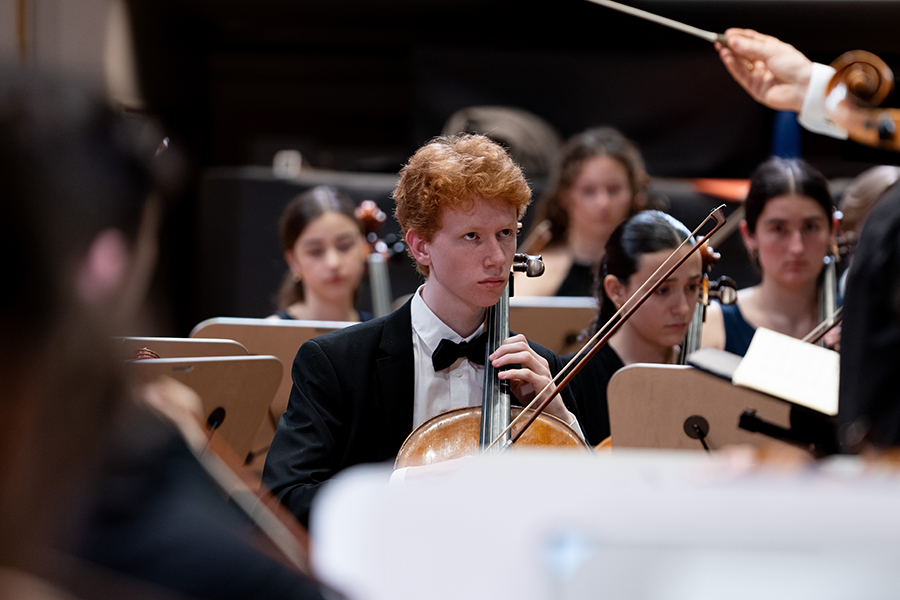
I think very fondly about my time in the Zurich Youth Symphony Orchestra and there are various highlights from the three years I was a member. The yearly concert tour was always something I looked forward to a lot, especially for the repertoire. In 2022 the orchestra toured in South Korea for two weeks playing in magnificent concert venues (Lotte Concert Hall and Daegu Concert House to name a few) and getting to see the country, performing among other works Tchaikovsky’s 5th Symphony and Sibelius’ Violin Concerto.
7- How often do your practice?
I’ve been setting myself a goal of 3-4 hours daily, when rehearsals and academics don’t fill up my day all too much.
8- Would you consider teaching in the future?
Teaching is actually something I’ve started looking into since coming to London. It’s an essential skill I think, especially because in order to teach it’s crucial that you understand the subject well enough yourself. And I’ve heard many times that one learns the most from their students. Of course also my past teachers were and still are a big influence on me so I would want to pass on that knowledge one day.
9- Who would your dream accompanist be, from the present or past?
Accompanist makes me think of pianists and the first one to come to mind is Vladimir Horowitz. I don’t need to convince anyone of his skill as a musician and he just seems like someone you would want to converse with, through music especially. On top of that, Rachmaninoff is one of his favoured composers, which I can only second.
10- What advice would you give to young musicians at the start of their journey?
Enjoy the process and embrace the nature of our profession. Being a musician is certainly not the most easygoing job in the world but it can be the most rewarding - “can be” because I firmly believe that one will only get out what they put into it. Make the journey enjoyable and you will make more progress.