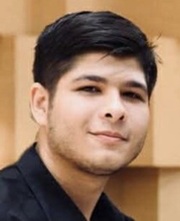
Interview
1- You are currently pursuing your postgraduate studies at the Royal College of Music under Professor Ieuan Jones. How is this progressing?
Everything is going very smoothly. I feel extremely fortunate to immerse myself in such a kind and supportive environment among my college professors and peers — especially in my lessons with my Principal Study teacher, Ieuan Jones, whose guidance always brings me a sense of ease and encouragement.
I also enjoy taking part in orchestral projects and attending interdisciplinary lectures — experiences that greatly broaden my horizons and constantly remind me how much joy and wonder there is in collaboration.
2- Who was your first music teacher?
My first musical experiences began in the symphony orchestra at the Songjiang Youth Activity Centre, where my harp teacher, Mrs. Juan Jiang, and the orchestra conductor, Mr. Weiqiang Yue, gave me my first guidance and valuable experiences of orchestral collaboration.
Afterwards, I met Professor Jason Chang, who recognised my potential and guided me towards professional musical training. His teaching and generous guidance have shaped my development both as a person and a musician, for which I remain deeply grateful today.
3- Is your family musical?
No, they aren’t. But they are both music lovers and fans of Mozart, which influenced my early childhood significantly. I still remember some of my cherished memories — my mother would use the music I was practising to create little stories, bringing each piece to life.
Listening to classical music was part of our family dinners, and we often went to concerts together. Music has accompanied my childhood, laying a strong foundation for my lasting interest and love for it.
4- You have won an impressive number of competitions. Does any one of these particularly stand out for you?
Yes, I would say that would be the Gold Medal in the Secondary II Pedal Division of the 4th Hong Kong International Harp Competition. It was my first Gold Medal, which is definitely of great importance.
I can still recall being on stage, performing my favourite composer for the harp, Elias Parish-Alvars — a moment when time seemed to be suspended. This has become an anchor I have carried into every challenge since, making me calmer and steadier to meet whatever comes.
5- You have also embarked as a composer the technical possibilities of the harp while integrating Eastern and Western musical traditions. Does any piece you have created stand in a special place for you?
Yes, it is called Whirling Dance Rhapsody. Inspired by a Tang Dynasty spinning dance, it is structured in six sections: Introduction, The Storyteller, The Mirage, The Fortune Teller, Preparation before the Campfire Party, and the final climax — The Whirling Dance. It employs a range of modern harp techniques, including bell ringing, soundboard clapping, and thunder gliss, to evoke the grandeur of the Western Regions of China. I have also revised a duet version for harp and tambourine.
This piece was selected as a finalist in the 7th USAIHC Ruth Inglefield Composition Competition and won Third Prize at the 5th World Championship in Composition, being described as “compelling, exciting, and a good showpiece” that requires both technique and musicality.
6- What are your fondest musical memories, privately or performing?
My fondest memories lie in the tours I took part in with ensembles and orchestras. I believe every journey outward leads inward, and I have always been drawn to exploring different places and cultures — listening, observing, and feeling my way through each encounter.
What stays with me most is the quiet connection formed through music and language — moments in which playing together, regardless of culture, nationality, or age, becomes something shared and unspoken, a simple yet profound kind of joy.
7- How often do you practice?
I stick to a daily routine of two hours of practice — a tradition I am trying to maintain around lessons, rehearsals, and performances. On free days, this might stretch into three or more hours to test my endurance.
When I have to be away from the harp, I practice another way — inside my mind. I will rehearse in silence, imagining myself playing in renowned venues. All these commitments help me build up my sense of security and confidence.
8- Would you consider teaching in the future?
Yes, I believe teaching is something that will arise naturally as I continue refining my craft towards a deeper level of artistry. To me, mastery is not only about personal achievement, but about reaching a point where sharing becomes inevitable. In that sense, teaching feels less like a decision and more like a continuation of the journey. I also feel a strong desire to carry forward the spirit and generosity of teaching that my tutors have passed on to me.
9- Do you find it difficult to balance your time and commitments? What are the biggest sacrifices?
I keep my days organized with both long-term and short-term plans, listing what I aim to accomplish while allowing space for reflection and curiosity. Balancing commitments is less about struggle and more about gentle prioritization. I do make choices that shape my time, though I rarely view them as sacrifices — I still find space for small hobbies like reading that refresh me. Perhaps the greatest cost is the discipline itself, but I actually regard it as a reassuring habit.
10- What advice would you give to young musicians at the start of their journey?
I would gently suggest that young musicians cultivate a mindset that is always curious, open, and respectful of the unknown — while maintaining a sense of awe for music. Build each skill like a castle and embrace challenges without giving way to arrogance. At the same time, try to develop an ability to judge, and to resist both distraction and noise. In every note, feel wonder, go a little further, and let your artistry carve your own piece of sky.
To return to Hanjiao’s profile: