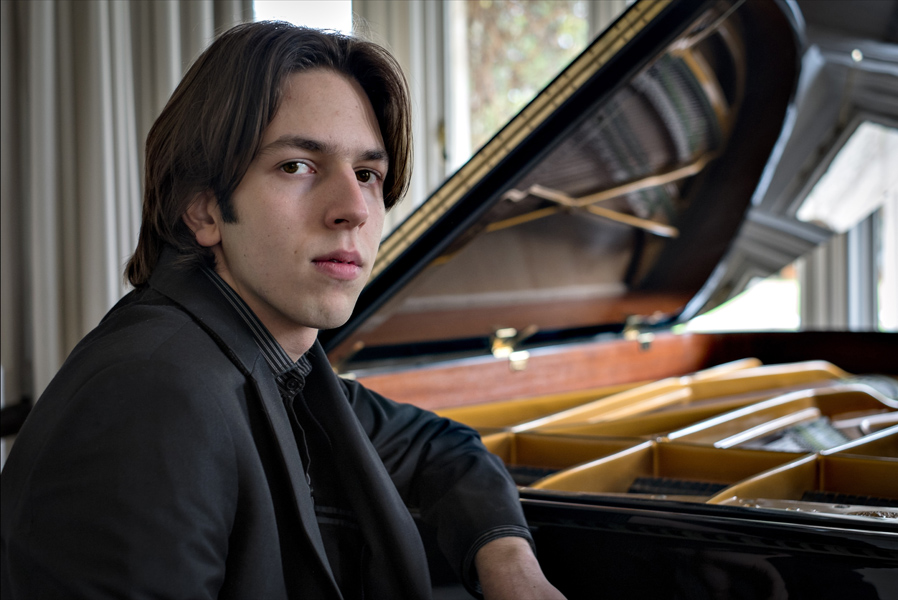
Interview
1- You began your studies as an eight year old with Maja Azabagic. How do you recall those years and this formative master for you?
I was very lucky to have ended with Maja Azabagic as she did not teach in a way that was governed by the curriculum. She sacrificed a lot of her free time to make sure I was prepared for upcoming competitions and other events. My approach to the Classical period was very much shaped by her and to this day I still notice the influence that those lessons left on me.
2- Is your family musical?
My father is a guitarist who for most part of his life was performed rock and blues. In the last 20 years his focus has been primarily on Balkan folk music as it is the predominant genre of music in our country.
3- You later studied at the Yehudi Menuhin School with Professor Marcel Baudet. How did this master influence you?
The Yehudi Menuhin School is where most of my development took place. Marcel, who I am still very close to, invested a lot of time and energy into his pupils. He took care of every aspect of our playing and made sure that we were on track with everything. He would often send follow up emails about our performances outlining the main problems that should be addressed. He also imparted a passion for art and history to his students. He would very often draw comparisons between art and music and would insist we acquaint ourselves with the traditions of each period of music.
4- You are currently studying at the Royal College of Music with Professor Dmitri Alexeev. How is this progressing?
Dmitri Konstantinovich is a remarkable musician and human being. During our studies I have come to accept the fact that phrase structure is the most important aspect of music. The struggles I underwent as a musician for years were all caused by the fact that I was not aware that structure is what makes music intelligible.
5- You come from Bosnia and Herzegovina, of which in the West our views are mostly coloured by a tragic war and little besides. How rich is that country’s classical music appreciation and do you see a possible role for yourself to introduce some of the composers from this nation to Western audiences?
Unfortunately Classical music does not have a very large audience in Bosnia and Herzegovina. As I already mentioned, Balkan folk music is the most popular genre of music in the Balkans. The millennials have sparked an interest for rock music, however Classical music still has no place.
6- You have won prizes in numerous international competitions. Does anyone particularly stand out for you?
The one that particularly stands out is the Beethoven Junior Intercollegiate Competition in London where I performed the Beethoven Les Adieux Sonata. This competition happened right after I recovered from an injury caused by excess practice on a digital piano reinstating my confidence in myself.
7- What are your fondest musical memories, privately or performing?
I still look back on the Gstaad Menuhin Festival, the 2016 edition, where I performed Rachmaninoff’s Second Piano Concerto. The Festival is in a prime location and has an unparalleled atmosphere.
8- How often do you practice?
Honestly I have stopped counting. Depending on what how busy you are and how many events you have to prepare for you should always aim for efficiency rather than quantity.
9- Would you consider teaching music in the future?
I have had the privilege assisting some of my fellow students at the Menuhin School as well as the RCM. It is something that I enjoy doing occasionally, but would not like to dedicate my entire professional life doing.
10- What advice would you give to young musicians at the start of their journey?
If you love music then you are sorted for life. One thing that I would warn young musicians of is the difficult periods that they will go through. Playing well is a prerequisite these days. You need to invest a lot of your time into your career development, because if you don’t you will find yourself stuck in the same place year after year.